Harrowing details of illegal multi-million-pound exotic pet ring busted in Shropshire revealed as four brought to justice
RSPCA inspectors have shared harrowing details of the day an illegal exotic pet ring was uncovered in Shropshire, after a fourth person was sentenced for their part in the scheme.
The RSPCA has shared its inspectors' harrowing accounts of Operation Herald, a major investigation that saw almost 2,000 exotic animals rescued from appalling conditions around Shropshire.
As part of warrants executed by West Mercia Police on December 10, 2020, police, RSPCA officers and exotic specialist vets removed 1,870 live animals along with 31 dead animals from four addresses across Shropshire.
Most animals were removed from Ellis Johnson Ltd at Cosford Grange Farm Shop, while 73 Hermann’s tortoises were found at Senorita Sparkles on Station Road in Newport.
Following a legal process spanning five years, the last of the four defendants involved in the case has been sentenced for their crimes.
In total, 1,870 live animals at Cosford Grange Farm were seized by the police, which included 1,061 leopard geckos, 294 sulcata tortoises, 18 reticulated pythons, 73 leopard tortoises, 22 rose belly lizards, 14 Chinese water dragons, 47 green basilisks, 10 smooth helmeted iguanas and 73 Hermann’s tortoises - among many other exotic animals.
When RSPCA rescuers entered, they discovered cold animals, barely moving, including some that had already died..
In a written statement provided to the court, RSPCA Inspector Kate Parker said that on December 10, 2020, she arrived at Cosford Grange Farm Shop along with West Mercia Police officers.
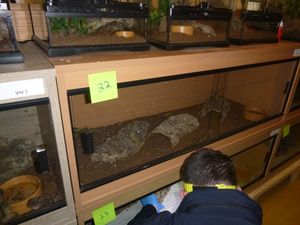
“I could instantly feel that it was cold inside. It was cold inside for any animal, let alone reptiles,” she said.
“I could see that from the many vivariums, tanks and tables there was not much movement, or immediately evident signs of life, from the animals inside.
"I could see that many of the set-ups had equipment, such as heat lamps, designed for the keeping of reptiles, however the plugs were not plugged into the sockets - or those that were had the switches off.
“From my initial observations, I saw some skeletons, decayed animals in vivs, dead tortoises and also some upside-down tortoises.
“I was surprised by the low temperatures, as the equipment that was being used within the premises, including bulbs, strip lights and UV lights, were of standard type for the upkeep of reptiles in a common setting. However they were not turned on and the plug switches were off, with some plugs removed from the sockets themselves.”
She also found two African grey parrots housed in a metal cage too small to reasonably house two birds of their size, with a nest box on the side of it.
The cage itself was filthy, with dried faeces and old, dried food crusted on the bars and at the bottom of the cage. She also noted some dirty water.
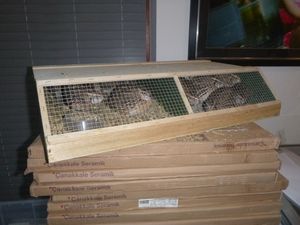
At another location in Wrockwardine, near Wellington, 15 quails were found in very cramped conditions which was far too small for all of them and a single quail was found on its own in the corner of the kitchen being kept in what were two plastic containers put together under a heat lamp. There was no food or water in either of the quail enclosures.
A bantam chick was found in an improvised brooder (where chicks are kept warm) made of plastic tubs with a heat lamp turned on, there was no water available and food, bedding and faeces were mixed together on the floor.
A juvenile monitor lizard was found in a cold small plastic tub without food or water and a crested gecko was found in a glass vivarium on top of a wardrobe. The temperature of 17C was too low, the animal was thin and no food was available.
Meanwhile 73 Hermann’s tortoises were found at Senorita Sparkles on Station Road in Newport, by police in a back office area.
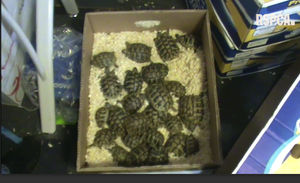
They were contained in three boxes that were stacked - each one containing tortoises. The tortoises were hardly moving and had no food or water present in the shavings. A vet examined these tortoises and said they were suffering predominantly due to dehydration.
The animals involved in the operation were then transported to vets for immediate treatment and subsequently transferred to boarding establishments and RSPCA centres/branches around the country. Sadly 399 animals died or were euthanised after they were removed on welfare grounds due to their poor conditions.
After sentencing, RSPCA lead exotics officer Inspector Kim Greaves, said: “This case was certainly one of the biggest exotics cases I’ve seen as an inspector.
“There were dead and dying animals and it was incredibly sad to see such beautiful animals in these conditions. These animals were then sold on to unsuspecting individuals and the pet trade, who probably had no clue they were being kept like this.
“This was a complex and distressing operation involving around 30 RSPCA officers - including six exotic officers - along with two vets who were exotic specialists. The operation went on for the entire day, with officers drafted in to collect animals and transport them to other locations.
“I was very proud of the exotic officers, and indeed all the inspectorate as it was a gruelling day but everyone worked hard to achieve and secure the best outcome. A personal thank you to Phil Hamilton from the RSPCA’s veterinary team whose work on the day was invaluable, helping to arrange places for the animals to go.”
Following the hearing, RSPCA chief inspector for the charity’s special operation unit, William Mitchell, said: “This was a massive operation for the RSPCA and I would like to thank the many rescue officers and inspectors who worked tirelessly on rescuing these animals, as well as the vets and exotics specialists who took on these animals for boarding at short notice.
“In particular RSPCA Inspector Kate Parker worked tirelessly coordinating the operation and investigation and this case has been a result of her commitment and hard work.
“Sadly a number of these exotic animals died or have been put to sleep to prevent suffering. Exotic animals have very specific needs and sadly in this case these animals were not cared for appropriately.
“Reptiles may look resilient and tough on the outside but they are actually completely reliant on their owners to provide the correct environment for the species, including heating and lighting, and an appropriate diet - all of which are essential to keep them healthy and allow them to carry out their natural behaviour. Without proper care they become ill or suffer and, in severe cases or if left untreated, they can die.
“We would like to thank West Mercia Police, National Wildlife Crime Unit, Telford & Wrekin Council and the private exotic vets for their support and expertise on this case.”
The majority of the exotics seized went into private boarding arranged by the RSPCA and when they were signed over officially to the care of the RSPCA a large number of the exotics stayed with the private boarder, who then rehomed them.
Other exotics went to RSPCA Brighton and RSPCA Stubbington Ark (RSPCA Solent Branch CIO). RSPCA Reptile Rescue in Brighton took on nearly 400 animals, including 138 leopard geckos, around 200 invertebrates and many other snakes and lizards.
The animals received the veterinary care they needed and many have now found new homes.
David Neville Johnson, aged 37, of Silvercroft Street in Manchester, pleaded guilty to nine offences under the Animal Welfare Act and was handed a suspended sentence on September 25 for 24 weeks in total, suspended for 18 months, and he was disqualified from keeping all animals for 16 years.
He was ordered to undertake 125 hours of unpaid work and up to 20 rehabilitation activity requirement days.
Shrewsbury Crown Court heard that Johnson was one of four people involved in the exotic pet ring, which also included his former partner, Tara Janine Watt, aged 36, who was sentenced to 12 weeks in prison, suspended for 18 months, earlier this year for her part in the scheme.