Age-old dilemma of new homes vs Shropshire's fields
Pip Davies walks along Oswestry's Iron Age hillfort. "I've been coming here since I was young," he says. "We've got to protect it, we've got to protect our heritage."
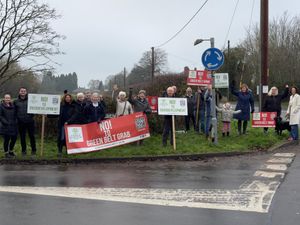
Few recent planning disputes have caused more emotion in the county than plans to build 117 houses on land in the shadow of the ancient fortress.
The proposals, recently approved in Shropshire Council's plans for the next decade, are in the spotlight once more after being highlighted by comedian Griff Rhys Jones in his TV series Griff's Great Britain.
But while the programme casts a terribly romantic image about people's love of the British countryside, it also highlights the problems faced by planners. On the one hand, the desire to preserve the county's landscape, which has been carefully preserved for generations. On the other is the desperate need for new homes.

Shropshire Council's SAMDev plan, signed off just before Christmas, committed the council to approving 18,000 new homes over the next decade. Neighbouring Telford & Wrekin has committed to 15,555 new homes over the next 15 years.
But, if past experience is anything to go by, achieving these targets will not necessarily be plain sailing.
One of the reasons Shropshire needs so many homes is that only 9,500 were built in the district over the past 10 years. This has caused it to fall behind an agreed target of 27,500 homes by 2026. If it is to meet the target, Shropshire will need to double its house-building rate.
So what has been the problem? Jonathan Woodcock, of family-run JRT Developments in Woore, near Market Drayton, blames the slow pace at which planning authorities move.
"Sometimes it's like treading through treacle," he says. "We have two schemes that have been going for years."
His father Frank recently wrote to MP Owen Paterson about the problems facing the construction trade. "These are the main reasons for lack of house building, council planning delays, and punitive costs for the right to build," he says.
Perhaps in recognition of this problem, the Government last month announced a shake-up of the planning process.
Under proposals, now going out for consultation, developers will be able to pay extra for a passport-style "fast-track" application process. More radical plans will also allow developers to choose which planning authority to submit their applications too.
Under the arrangement, the final decision would still be made locally, but local authorities would compete against one another to handle the administrative side of the process. There has even been the suggestion of private companies being licensed to carry out the work.
Communities secretary Greg Clark says: "These proposals will be a boost for housebuilders looking to build much-needed homes, and for local people looking to get a planning permission for home improvements through their local council quicker."
Mr Woodcock has mixed views. "It's a little bit rich that the councils are failing so badly with planning permission that we have got to pay to fast-track them," he says. "It's just more costs for the developer."
He is more hopeful about the idea of giving developers a choice of which local authority to apply to, though.
"I think it is definitely something our company would use," he says.
The proposed shake-up has not gone down well with Vernon Bushell, a Labour councillor from Shrewsbury who is chairman of Shropshire Council's central planning committee. "I don't like it at all," he says. "I don't know how they are going to run it, but I think it is best handled locally by our planning officers."
He foresees the difficulties coming through marginal cases, where an officer's local knowledge can be crucial in deciding how to proceed.
"Sometimes the officers will talk to the local councillors, they might say 'do you think this one should come to committee?'
"Our officers are great, this is just another example of Government interference, and I don't think it is for the best."
Conservative councillor Arthur Walpole, who is chairman of the south Shropshire planning committee, says he too has mixed thoughts about allowing other planning authorities to administer sensitive developments in the county.
"I'm all for more competition if it improves efficiency, but we also depend a lot on local knowledge," says Councillor Walpole. "Well over 90 per cent of applications are decided by the officers under delegated powers, I don't know how that would work. I would want to see the response from the public."
In neighbouring Telford & Wrekin Council, there has been a fierce debate over the past few weeks regarding how many houses actually need to be built. Last month, leader of the opposition Conservative group, Councillor Andrew Eade, accused the Labour-run council of inflating its housebuilding targets, saying its "duty to cooperate" report published in January stated that just 9,940 new homes were needed to meet local demand.
However, Labour's Councillor Richard Overton says the local plan has actually cut the number of new homes to be built in the borough by more than 40 per cent from when the Tories were in control, in 2010.
Telford & Wrekin's communications officer Emily Knightly says the council is at the forefront of initiatives to improve and speed up the planning process, including effective use of local development orders, where authorities grant advanced planning permission for certain types of development in specified areas, meaning builders do not then need to go through the planning process.
"In this respect Telford & Wrekin is already with, if not ahead of, the Government in helping to speed up the process and make it as effective as possible for applicants."
Of the Government's proposed planning shake-up, she says: "The implication of some of the proposed measures are still unclear and we will have to work through these as they emerge. For example, the full implications of planning in principle is still not worked through and does not mean that applications don't need to be processed.
"There is no clear overall model of what is the best way to run planning services – combine with other authorities, go private – but whichever model is adopted, the council's objective would be to maintain quality standards of planning whilst making the process as fair, fast and effective as possible."
The Government plans have been given a cautious welcome by the Federation of Master Builders, which represents about 9,000 small construction firms across Britain.
The federation's chief executive Brian Berry says: "It's very welcome news that the Government has listened to the concerns of industry over the sclerotic planning system.
"Across the country, house builders continue to be frustrated by a painfully slow planning process. The numerous sources of delays and inefficiencies in the system impact upon house building rates, and act as a major deterrent to small developers."
But he also points out the changes will only work if local authorities put sufficient resources into their planning departments.
"Local authorities need to be able to invest in their planning departments to put in place, and renew, their local plans. Fees, whether fast-track or standard, need to be weighted to ensure that overall the system will be adequately resourced."
Whether it will solve the age-old dilemma of balancing the need for housing with demands to preserve the countryside is another matter. Councillor Bushell says: "Planning is always controversial. You please some people, and you upset others."