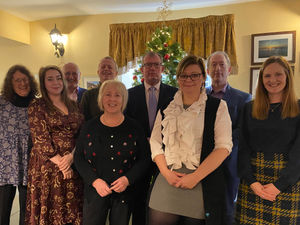
New era for village hall
Neil Thomas discovers that investment has brought a whole new set of challenges for a village hall on the Shropshire/Powys border.

 Neil Thomas discovers that investment has brought a whole new set of challenges for a village hall on the Shropshire/Powys border.
Village halls are not conspicuously the stuff of business supplements. The traditional image is of draughty, delapidated buildings housing WIs, pensioners' whist drives, jumble sales, parish councils, pre-school playgroups, wedding receptions and birthday parties.
The hub of their communities for sure, but at the cutting edge of enterprise . . . ?
How times change. Vast sums of public money have been invested in the renovation of rundown halls over the past decade or more - and the pay-off is that they must be economically sustainable.
Halls, today, must pursue custom in the same way as any other business. In short, they must actively drum up business, tuning in to every revenue-generating opportunity going.
A shining example of this modern phenomenon can be found on the Shropshire/Powys border.
The hall at Llanymynech is undergoing a major refurbishment which is turning it into a stunning centre serving a far-flung population of more than 2,500.
A newly-built extension is already open while the renovated main hall is due to be unveiled at a two-day ceremony on February 29 and March 1, with local MPs and civic dignitaries set to attend.
The scheme sees the hall assume the status of social enterprise centre, playing a central role in the economic regeneration of the area.
Like most businesses of any size, Llanymynech Village Hall Enterprise Centre has a marketing officer. Enid Lintern's role is to raise the centre's profile and sell its services far and wide.
There is plenty to sell. The new extension houses an exhibition foyer, two smart and comfortable meeting rooms and a broadband-enabled 10-place information technology suite. There's a state-of-the-art kitchen and the centre can also bring in outside catering.
You see, Llanymynech Village Hall is keen to become part of the conferencing industry. Enid believes the centre offers ideal facilities for small and medium-sized businesses and educational establishments to stage events.
"We have two excellent, modern meeting rooms as well as a large meeting space in the main hall. We can bring in top quality catering, which makes this an excellent place for conferences, seminars, training days, networking events, workshops and marketing forums," she says.
 "The centre is geared to the needs of business and we are hopeful that we can attract businesses to use our facilities here and that interest in using the centre for such events will grow.
"There is great scope, even locally. There are 44 businesses in the Llanymynech area alone, so the potential is there. Many are run by one person in their home and the networking opportunities offered by the village centre could help bring them together for mutual support. That's important to people working from home. They need to share problems and solutions."
The centre has already hosted business-related events, from an event run by WiRE (Women in rural Enterprise) to a Business Support Clinic staged by Oswestry Borough Council in conjunction with Business Link West Midlands. Rural enterprises booked appointments with an advisor to discuss topics ranging from business planning and grants to VAT and marketing.
A Farming IT course was launched only last week, open to those in agriculture who want to improve their skills in an industry whose administrative side is becoming increasingly computer-dominated.
Related to the world of business and work is the need for quality childcare and the new extension at the hall houses a 24-place pre-school suite, plus outdoor play area, offering afterschool and holiday playcare. It is run by non-profit-making Border Pre-School, which celebrates its 30th anniversary this year, 20 of them spent in Llanymynech after an initial period in nearby Llandrinio.
"The facilities here are excellent, wonderful for the children," says pre-school leader Sandra Hayward.
The hall also doubles up as an outreach college, helping to take education out to the remoter rural areas that don't have such facilities on the doorstep. To that end, both North Shropshire College and Coleg Powys stage courses there.
On the sports side, work on a high standard shower block and sports changing rooms for users of the adjacent playing fields is nearing completion.
"The shower block and changing rooms were funded mainly by the Football Foundation, whose exacting standards had to be met, standards much higher than would otherwise have been the case," says Enid.
Modernising
Work on modernising the main hall, including up-to-date lighting and sound equipment with a stage and raked seating system for arts and drama, is also nearly finished.
When the whole project is complete, the hall will bear virtually no resemblance to the building which opened in 1947 as a gift of local patron, The Earl of Bradford.
The village is split by the England/Wales border, with half in Shropshire and the other half in Powys, the A483 road providing the border.
The cross-border co-operation that this has engendered is a "unique selling point" for the village, says Enid.
"This means that delivery agencies such as Age Concern, for instance, from each side of the border can unite to offer a complementary service which wouldn't be possible for either on its own.
"It also offers a bigger catchment area for marketing and networking."
It means the village can attract vital finance from both sides of the border. Initial funding came from the European Union (ERDF) and most of the project is match funded with English and Welsh money.
This particular chapter in the nation's village hall revolution is taking place in one of the region's most historic villages. Llanymynech can trace its roots back to Roman times and is recognised as one of Shropshire's most important heritage sites. The village was an important lime-making centre in Britain in the 19th and 20th centuries, limestone from the rocks turned into lime in huge kilns and then transported via the canal and rail network across the country.
The limeworks, untouched for more than a century, are undergoing major restoration as part of a £1 million heritage project.
Restoration of the Tally House - built in the early 1870s and used for weighing limestone-laden trucks and then dispatching them to the kilns, the canal or the railway - has been at the centre of the project. It will form part of the Limestone Story Trail that will take visitors from the quarries down through the internationally-important Hoffman Kiln and then to the canal.
A trip in a narrowboat and a guided walk around the heritage area are part of the Llanymynech Visitor Experience, which aims to boost the local economy and raise funds for canal and heritage-based trusts in the village.
British Waterways is investing millions of pounds in a restoration of the Montgomery Canal, including the stretch through Llanymynech, which it believes will boost visitor numbers.
In addition, the Cambrian Railways Trust has the long-term goal of re-opening the entire eight-and-a-half mile stretch of track between Gobowen and Llanymynech as a heritage railway. Again it is estimated this would lure thousands of visitors to the area.
Llanymynech, it seems, is developing apace to embrace one of Britain's boom industries of the 21st century - tourism.
Perhaps even more pertinently, the village has grasped one of the most important concepts on the business landscape of post-industrial Britain - enterprise.
By Neil Thomas